Does your child touch your feet? One of the most important aspects of Indian culture is respect for parents, and for age.
Although India prides itself on having a rich culture and heritage, few Indian are aware of their culture and traditions, and it is not unusual for us to come across people from outside India, or Indians living abroad, who are more aware of India's rich heritage than we are.
For most Indians, being aware of our culture simply means touching our grandparent's feet once in a while, knowing a little of the Mahabharata, knowing that Rama was good and Ravan was bad, and not walking out of a marriage, no matter what the cost.
However, there is a lot more to culture than just this. In this article, we touch on just one of the many aspects: respect for age.
Arguments
Children are often taught to respect age. However, as experience has time and again shown us, an elder person is not always right. If you try and force your child to listen to someone like a grandparent just because he is older, you may sow the seeds of resentment in your child. Instead of forcing your child to bow down before age, focus on teaching your child how he can express his opinion without being rude to his elders. Also, teach him that is perfectly acceptable to have two points of views for different situations, and, although he is perfectly entitled to his point of view, there is no need for him to force it on others. A common dispute between children and parents or grandparents is that of vulgarity. A child may be watching MTV, while his grandmother crops up and comments on how obscene a particular music video is. In such cases, teach your child that obscenity is a point of view. If your child doesn't think it is obscene, that should not form a base for argument. Teach your child that it is mature and open-minded behavior to let another person, especially someone elder, state his point of view, without jumping in to argue.
Touching Feet
Youngsters today are often uncomfortable with touching the feet of elders. If your child feels this way, don't force him to touch your feet or the feet of his grandparents. Instead, work by example. If you don't touch the feet of your mother, don't expect your child to, especially if this habit has not been inculcated since childhood. If you would like your child to touch your feet every morning, make this a habit from his childhood. If he doesn't one morning, don't let it slide, or gradually the habit may die down. Every time your child touches your feet, do give him your blessings, and give him a hug. If you brush him off or are distracted, he may not bother doing so again. Also, children often shy away from touching feet in public, so it may help if you encourage him to touch your feet even in public, from a young age. Touching the feet of your parents is simply a mark of love and respect for them, and a request for their blessings. These days, generally only a person fairly self-confident and comfortable with himself, his heritage and where he comes from can touch their parent's feet in public, without feeling self-conscious.
Monday, February 28, 2011

Friday, February 11, 2011
India Pilgrimages: Kailash Mansarovar

 Apparently Mount Kailash was discovered by king Gurlamandhata, after whom the highest Mt. Gurula (Mamonani) is named. At 22,027 ft, is said to have been formed 30 million years ago during the early stages of the formation of the Himalayan chain. In geological terms, Kailash stands alone, the world’s largest deposit of tertiary conglomerate.
The Vishnu Purana (approx 200 BCE) described how the world is made up of seven continents ringed by seven oceans — “The central continent has Meru at its core, bounded by three mountain ranges to the north and three to the south. One of these ranges is the Himalayan barrier, interposed between Meru and ‘Bharatha’, the Indian subcontinent. Meru, the center, is Mount Kailash.
 Mount Kailash has been one of the greatest mysteries for cartographers till about 1800. All they knew was that there stood a sacred mountain, an Asian Olympus of cosmic proportions. This mountain was said to be the navel of the earth and the axis of the universe and from its summit flowed a mighty river that fell into a lake, and then divided to form four of the great rivers of Asia.The earliest European record dates to 1715, from an Italian Jesuit called Ippolito Desideri, who passed Kailash on the way to Lhasa. John Rennell, the ‘Father of Indian Geography’, in his 1782 map of Hindustan, followed the Hindu belief that the Ganga had its fountainhead beyond the Himalaya at the sacred Manasarovar Lake, that the Ganga flowed south till the “great chain of mount Himmaleh” and forced its way through a trans-Himalayan tunnel. It was only in 1812 when Hyder Jung Hearsey and Dr William Moorcroft crossed over the Niti Pass and surveyed the Manasarovar area that this geographical inaccuracy was corrected.
“Man likes to be at his best, but often nothing short of a Himalaya peak can extract it from him–can compel him to be fittest in body, alertest in mind and firmest in soul. So he is drawn to the mountain and the mountain makes a man out of him,” wrote Sir Francis Younghusband who had subjugated Tibet for the British and conquered the peak of Kamet.Mansarovar was first created in the mind of Brahma. Both Kailash and Manasarovar find mention in the Skanda Purana, Vishnu Purana, Ramayana and Mahabharata. Mansarovar, at 14,950 feet and area of 320 km is one of the highest and largest fresh water lakes in the world.
The lake is majestically calm and dignified like a huge bluish green emerald or a pure turquoise set between the two mighty and equally majestic silver mountains, the Kailash on the north and the Gurla Mandhata on the south and between the sister lake Rakshas Tal or Ravan Harda on the west and some hills on the east.Parikrama of Mansarovar and Mount Kailash are not just an athletic feat. It is said that after its parikrama, one is freed from the cycle of birth, death and rebirth. In the parikrama of Kailash (Kongrigpoke) one has to walk 55 kms. and its highest point is Dolmapass at 19000 ft. This pilgrimage has been undertaken for centuries, and was only briefly stopped between 1959-1980.
“There are no mountains like the
Himalaya, for in them are Kailas
and Mansarovar. As the dew is
dried up by the morning Sun, so
are the sins of mankind dried up
by the sight of the Himalaya.”
-Skanda Puran
Next to Mansarovar, there is another lake called Rakshas Tal. It is spread over the area of 225 sq. km. Here demon king Ravana worshipped Ashutosh Shambhu, that is why it is called Rakshas Tal or Ravanhrid. There are two beautiful islands within Rakshas Tal. A narrow hill separates Mansarovar and Rakshas Tal. A small river called Ganga-Chu joins both the lakes. Satlaj, Sindha Brahmputra etc. famous rivers originate from this region.
There are eight Buddha Gompas situated on the banks of Mansarovar. There is a vast Plane called Barkha on the north side of Mansarovar. Darchen is on the North side of Barkha. Kailash Parikrama starts from Darchen.
The journey to abode of Shiva is 1,800 km from Delhi and back, of which over 400 km are done on foot or ponyback. Mount Kailash and Mansarovar are called Kangrinboque (The Sacred Mountain) and Mapam Yumco (The Sacred Lake) respectively by the Buddhists. The Jains claim that Adinath Rishabhdeva, their first Tirthankara, attained his nirvana here. Padmasambhava, who took Buddhism to Tibet in the eighth century, spent the last seven years of his life in this region. Bonpa, the ancient Tibetans, see a nine story ‘swastik’ in it and consider it an abode of Damchauk and Dorge Phangmo. For believers of Hinduism, Jainism, Tibetan, Bongboism and Buddhism it is center of the world.
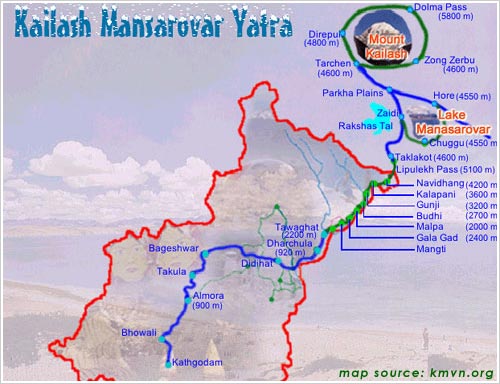 The management of this yatra is done by Ministry of External Affairs in Indian region through Kumaon Mandal Vikas Nigam, and Tibetan tourism agency in Tibet respectively. It can cost you around Rs 35,000. You can undertake this pilgrimage only after you have cleared all medical exams. It is a 26 day trip.
Today you even have the option of ‘Quick Kailash’ or ‘heli-Kailash’. Yes, aerial parikrama!
Update: I came across this wonderful video on Kailash Mansarovar Yatra which I would like to share with you here-
10 reasons you want to marry indian man
Over the years, Indian men got a bad name all over the world. Most women complain about immaturity, insensitivity, and insufficient evolution of Indian men. The demand for dowry did not help the image at all. The news of burning bride turned most women against them. But ladies no one ever tells you about the advantages of marrying an Indian man. If only you knew the truth, you are surely to see them in a new light. Maybe even consider them when you are ready to take the plunge. If you are already married, maybe you can tell your friends about them. So here are the top ten reasons to marry an Indian man.
- 10. They come in a family pack. You get a mother, a father, a few sisters-in-law, half dozen cousins, and countless relatives for free.
- 9. They would never leave you. They get fat and lazy too fast and no woman will ever be interested in them.
- 8. You will never get tired of hubby improvement projects. They come with countless imperfections and guaranteed to be really slow learners.
- 7. Despite their crude exterior and rude attitude, they are docile at heart. They are well trained by their mother to follow orders from woman of the house. You are in control.
- 6. They would be grateful all their lives; all other 37 girls they interviewed turned them down.
- 5. They will be available all the time. They do not have any friends or social life or passion to keep them busy.
- 4. You never have to worry about their past girlfriends: most likely they never had one, or in the rare case they had a girlfriend, she is too busy erasing the memory.
- 3. You will earn the sympathy of everyone, even your worst enemy.
- 2. They will stop harassing you once you marry them.
- 1. They will fight for their love once you can touched their heart for sure.
Driving in India ... Scaring drive !!!

Driving On Indian Roads: Can you do it?
Indian road rules broadly operate within the domain of karma where you do your best and leave the results to your insurance company. Here is a funny, and sadly true account by Coen Jukens on driving in India.
The hints are as follows:
Do we drive on the left or right of the road? The answer is “both”. Basically you start on the left of the road, unless it is occupied. In that case, go to the right, unless that is also occupied. Then proceed by occupying the next available gap, as in chess.
- Just trust your instincts, ascertain the direction, and proceed. Adherence to road rules leads to much misery and occasional fatality.
- Most drivers don’t drive, but just aim their vehicles in the intended direction. Don’t you get discouraged or underestimate yourself. Except for a belief in reincarnation, the other drivers are not in any better position.
- Don’t stop at pedestrian crossings just because some fool wants to cross the road. You may do so only if you enjoy being bumped in the back. Pedestrians have been strictly instructed to cross only when traffic is moving slowly or has come to a dead stop because some minister is in town. Still some idiot may try to wade across, but then, let us not talk ill of the dead.
- Blowing your horn is not a sign of protest as in some countries. We horn to express joy, resentment, frustration, romance and bare lust (two brisk blasts) or just to mobilize a dozing cow in the middle of the bazaar.
- Keep informative books in the glove compartment. You may read them during traffic jams, while awaiting the chief minister’s motorcade, or waiting for the rain waters to recede when over-ground traffic meets underground drainage.
- Night driving on Indian roads can be an exhilarating experience (for those with the mental makeup of Genghis Khan). In a way, it is like playing Russian roulette, because you do not know who amongst the drivers is loaded. What looks like premature dawn on the horizon turns out to be a truck attempting a speed record. On encountering it, just pull partly into the field adjoining the road until the phenomenon passes. Our roads do not have shoulders, but occasional boulders. Do not blink your lights expecting reciprocation. The only dim thing in the truck is the driver and the peg of illicit arrack he has had at the last stop; his total cerebral functions add up to little more than a naught. Truck drivers are the James Bonds of India and are licensed to kill. Often you may encounter a single powerful beam of light about six feet above the ground. This is not a super motorbike, but a truck approaching you with a single light on, usually the left one. It could be the right one, but never get too close to investigate. You may prove your point posthumously. Of course, all this occurs at night, on the trunk roads.
During the daytime, trucks are more visible, except that the drivers will never show any signal. (And you must watch for the absent signals; they are a greater threat.) Only, you will often observe that the cleaner that sits next to the driver will project his hand and wave hysterically. This is definitely not to be construed as a signal for a left turn. The waving is just an expression of physical relief on a hot day.
Occasionally you might see what looks like an UFO with blinking colored lights and weird sounds emanating from within. This is an illuminated bus, full of happy pilgrims singing bhajans. These pilgrim buses go at breakneck speed, seeking contact with the Almighty, often meeting with success.

Getting Around, Indian Style
Unique to Indian traffic:
Auto Rickshaw (Baby Taxi)
The result of a collision between a rickshaw and an automobile, this three-wheeled vehicle works on an external combustion engine that runs on a mixture of kerosene oil and creosote. This triangular vehicle carries iron rods, gas cylinders or passengers three times its weight and dimension, at an unspecified fare.
After careful geometric calculations, children are folded and packed into these auto rickshaws until some children in the periphery are not in contact with the vehicle at all. Then their school bags are pushed into the microscopic gaps all round so those minor collisions with other vehicles on the road cause no permanent damage. Of course, the peripheral children are charged half the fare and also learn Newton’s laws of motion en route to school. Auto-rickshaw drivers follow the road rules depicted in the film Ben Hur and are licensed to irritate.
Mopeds
The moped looks like an oil tin on wheels and makes noise like an electric shaver. It runs 30 miles on a teaspoon of petrol and travels at break-bottom speed. As the sides of the road are too rough for a ride, the moped drivers tend to drive in the middle of the road; they would rather drive under heavier vehicles instead of around them and are often “mopped” off the tarmac.
Leaning Tower of Passes
Most bus passengers are given free passes and during rush hours, there is absolute mayhem (hell). There are passengers hanging off other passengers, who in turn hang off the railings and the overloaded bus leans dangerously, defying laws of gravity but obeying laws of surface tension. As drivers get paid for overload (so many Rupees per kg of passenger), no questions are ever asked. Steer clear of these buses by a width of three passengers.
One-way Street
These boards are put up by traffic people to add jest in their otherwise drab lives. Don’t stick to the literal meaning and proceed in one direction. In metaphysical terms, it means that you cannot proceed in two directions at once. So drive as you like, in reverse throughout, if you are the fussy type.
Lest I sound hypercritical, I must add a positive point also.
Rash and fast driving in residential areas has been prevented by providing a “speed breaker”; two for each house. This mound, incidentally, covers the water and drainage pipes for that residence
and is left un-tarred for easy identification by the corporation authorities, should they want to recover the pipe for year-end accounting.
If, after all this, you still want to drive in India, have your lessons between 8 pm and 11 am – when the police have gone home. The citizen is then free to enjoy the ‘FREEDOM OF SPEED’ enshrined in our constitution.
Having said all this, isn’t it true that the accident rate and related deaths are less in India compared to US or other countries ?
Subscribe to:
Posts (Atom)