
 Apparently Mount Kailash was discovered by king Gurlamandhata, after whom the highest Mt. Gurula (Mamonani) is named. At 22,027 ft, is said to have been formed 30 million years ago during the early stages of the formation of the Himalayan chain. In geological terms, Kailash stands alone, the world’s largest deposit of tertiary conglomerate.
The Vishnu Purana (approx 200 BCE) described how the world is made up of seven continents ringed by seven oceans — “The central continent has Meru at its core, bounded by three mountain ranges to the north and three to the south. One of these ranges is the Himalayan barrier, interposed between Meru and ‘Bharatha’, the Indian subcontinent. Meru, the center, is Mount Kailash.
 Mount Kailash has been one of the greatest mysteries for cartographers till about 1800. All they knew was that there stood a sacred mountain, an Asian Olympus of cosmic proportions. This mountain was said to be the navel of the earth and the axis of the universe and from its summit flowed a mighty river that fell into a lake, and then divided to form four of the great rivers of Asia.The earliest European record dates to 1715, from an Italian Jesuit called Ippolito Desideri, who passed Kailash on the way to Lhasa. John Rennell, the ‘Father of Indian Geography’, in his 1782 map of Hindustan, followed the Hindu belief that the Ganga had its fountainhead beyond the Himalaya at the sacred Manasarovar Lake, that the Ganga flowed south till the “great chain of mount Himmaleh” and forced its way through a trans-Himalayan tunnel. It was only in 1812 when Hyder Jung Hearsey and Dr William Moorcroft crossed over the Niti Pass and surveyed the Manasarovar area that this geographical inaccuracy was corrected.
“Man likes to be at his best, but often nothing short of a Himalaya peak can extract it from him–can compel him to be fittest in body, alertest in mind and firmest in soul. So he is drawn to the mountain and the mountain makes a man out of him,” wrote Sir Francis Younghusband who had subjugated Tibet for the British and conquered the peak of Kamet.Mansarovar was first created in the mind of Brahma. Both Kailash and Manasarovar find mention in the Skanda Purana, Vishnu Purana, Ramayana and Mahabharata. Mansarovar, at 14,950 feet and area of 320 km is one of the highest and largest fresh water lakes in the world.
The lake is majestically calm and dignified like a huge bluish green emerald or a pure turquoise set between the two mighty and equally majestic silver mountains, the Kailash on the north and the Gurla Mandhata on the south and between the sister lake Rakshas Tal or Ravan Harda on the west and some hills on the east.Parikrama of Mansarovar and Mount Kailash are not just an athletic feat. It is said that after its parikrama, one is freed from the cycle of birth, death and rebirth. In the parikrama of Kailash (Kongrigpoke) one has to walk 55 kms. and its highest point is Dolmapass at 19000 ft. This pilgrimage has been undertaken for centuries, and was only briefly stopped between 1959-1980.
“There are no mountains like the
Himalaya, for in them are Kailas
and Mansarovar. As the dew is
dried up by the morning Sun, so
are the sins of mankind dried up
by the sight of the Himalaya.”
-Skanda Puran
Next to Mansarovar, there is another lake called Rakshas Tal. It is spread over the area of 225 sq. km. Here demon king Ravana worshipped Ashutosh Shambhu, that is why it is called Rakshas Tal or Ravanhrid. There are two beautiful islands within Rakshas Tal. A narrow hill separates Mansarovar and Rakshas Tal. A small river called Ganga-Chu joins both the lakes. Satlaj, Sindha Brahmputra etc. famous rivers originate from this region.
There are eight Buddha Gompas situated on the banks of Mansarovar. There is a vast Plane called Barkha on the north side of Mansarovar. Darchen is on the North side of Barkha. Kailash Parikrama starts from Darchen.
The journey to abode of Shiva is 1,800 km from Delhi and back, of which over 400 km are done on foot or ponyback. Mount Kailash and Mansarovar are called Kangrinboque (The Sacred Mountain) and Mapam Yumco (The Sacred Lake) respectively by the Buddhists. The Jains claim that Adinath Rishabhdeva, their first Tirthankara, attained his nirvana here. Padmasambhava, who took Buddhism to Tibet in the eighth century, spent the last seven years of his life in this region. Bonpa, the ancient Tibetans, see a nine story ‘swastik’ in it and consider it an abode of Damchauk and Dorge Phangmo. For believers of Hinduism, Jainism, Tibetan, Bongboism and Buddhism it is center of the world.
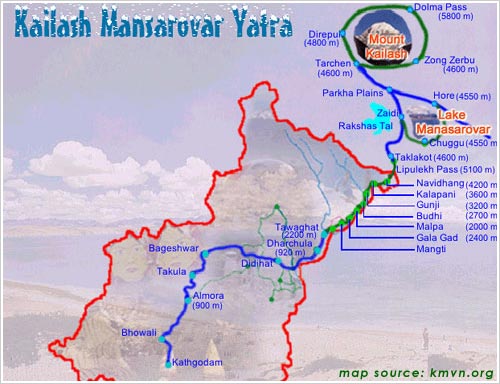 The management of this yatra is done by Ministry of External Affairs in Indian region through Kumaon Mandal Vikas Nigam, and Tibetan tourism agency in Tibet respectively. It can cost you around Rs 35,000. You can undertake this pilgrimage only after you have cleared all medical exams. It is a 26 day trip.
Today you even have the option of ‘Quick Kailash’ or ‘heli-Kailash’. Yes, aerial parikrama!
Update: I came across this wonderful video on Kailash Mansarovar Yatra which I would like to share with you here-

I have visited various destinations, but whenever i read your blog, my senses are left spell bound for a minute and i'm forced to go weave the imaginative cob webs in my mind. I liked your blog and would like you to explore more on Kailash Manasarovar Yatra 2013, Pilgrimage tour packages in India.
ReplyDelete